

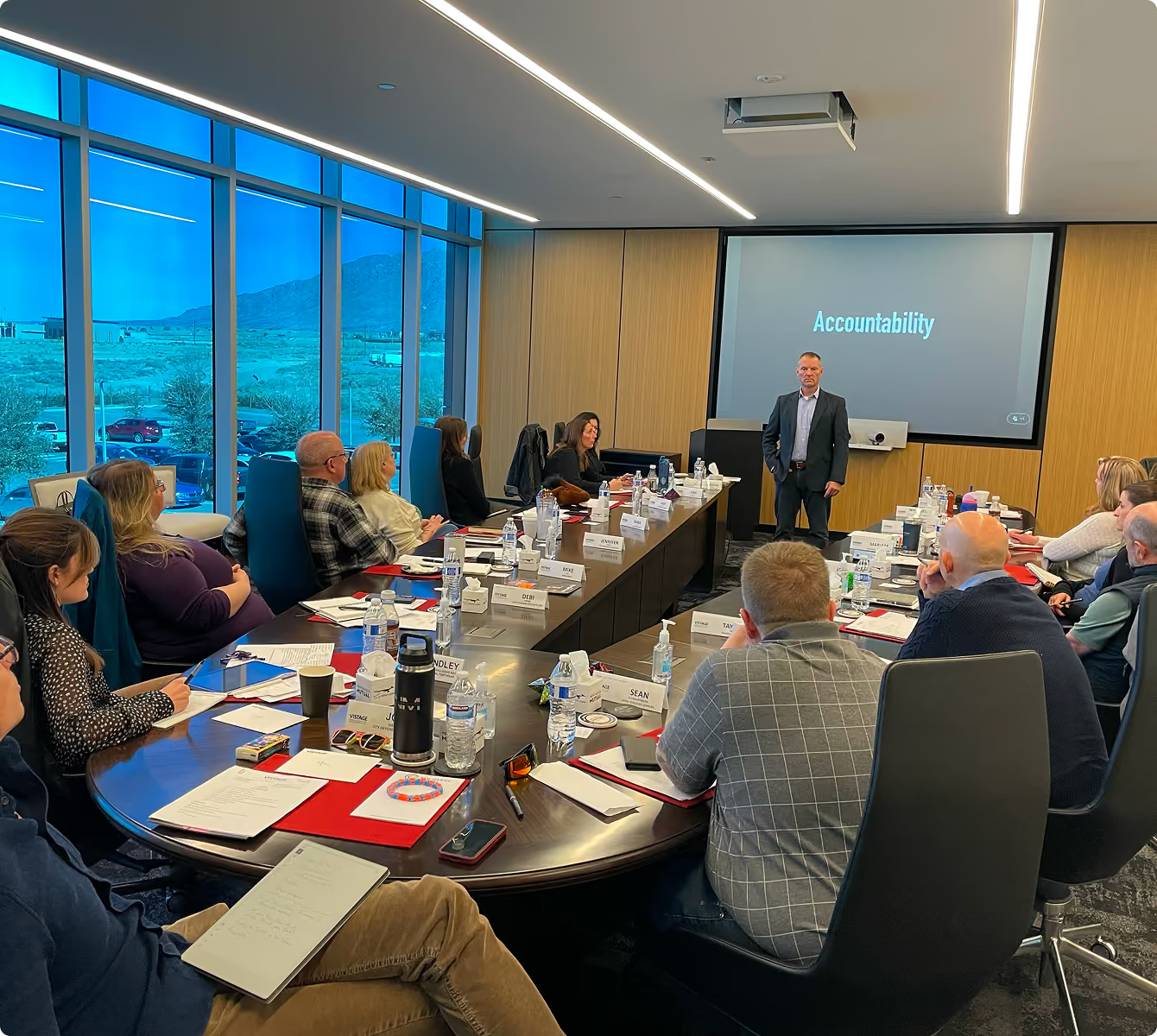
A "no-blame" debrief (fighter pilots just call this a debrief) is how a team stops repeating the same mistakes. A meta-analysis of 46 samples covering 2,136 people, conducted by Tannenbaum & Cerasoli and published in Human Factors, concluded that properly conducted debriefs improve performance by 20 to 25 percent. Most teams still skip the step, and the ones that do hold a review often turn it into a hunt for the guilty.
What is a no-blame debrief?
A "no-blame debrief," formally speaking, is an efficient team review. Essentially, it asks three things: 1) What happened? 2) Why did it happen? 3) What will we change next time? It also looks at the system, and not necessarily the person, though the person's adherence to and execution of the system matters. At VMax Group, we call our version the "F-4 Debrief." The only point of this process is learning, as a team, not laying blame or finding fault, per se.
Most teams look back at their work in some fashion, but few do it in a way that structurally changes anything. The default review asks a single question: "Whose fault was this?" and everybody in the room can feel it coming and dreads the outcome. People in this setting focus on managing their exposure rather than describing what actually happened. They volunteer less each time, hedge a little more, and the real cause stays exactly where it was. Three months later, the same failure arrives wearing a different name.
A no-blame debrief, or a debrief, is built to work differently. A no-blame debrief is a team review that turns a miss into a fix, not an exercise in finding fault. The team examines the plan it was working to achieve. It then examines the handoffs between the people involved, the decisions that were made, along with the information the decision-makers had available. This detail matters, because a call that looks obviously wrong in hindsight was often entirely reasonable at the time the person made it, given the context.
The term "no-blame debrief" tends to throw some leaders off. Therefore, it's worth being precise about what it means, as well as what it doesn't. And it definitely doesn't mean that everyone gets a pass. It means the review is directed at the system that produced the result, as well as how well the people in the system followed it. Put another way, blame ends a conversation, whereas learning keeps it going, and energizes it.
What's interesting is that none of this is new. The US military formalized the practice during World War I, and fighter squadrons have debriefed every flight, win or lose, ever since. They do so because the debrief is by far the best team learning device they have. Fighter squadrons have to learn from mission to mission to have confidence they're going to win when the stakes are highest. At VMax Group, we teach our proprietary version, the F-4 Debrief, as the closing step in a loop that's described as follows: Plan, Brief, Execute, Debrief. Our Founder, Lt Col (ret) Robert "Cujo" Teschner, led the instruction of this loop as an F-15C instructor at the US Air Force Weapons School, and he outlined his experience as the US Air Force's Subject Matter Expert on team debriefing in his book Debrief to Win. His line on winning is blunt: "Unless we understand WHY we won, it will be difficult to replicate it."
Why does my team keep making the same mistakes?
Teams repeat mistakes because people fail to address the root causes out loud, and fear does the rest. Mental Health First Aid England asked 2,000 UK workers about this phenomenon. They found 45 percent of people surveyed don't feel safe when they raise a mistake or highlight a risk at work.
That survey, run by OnePoll between December 2025 and January 2026 and published on 9 February 2026, is worth reading closely, because the detail underneath the headline number is where the business costs sit. Almost one in seven workers, a full 15 percent, said they had already made a preventable mistake as a direct result of feeling unsafe. Just under half, 49 percent, didn't feel comfortable expressing what they need at work. Just over a third, 35 percent, didn't feel safe asking for help. Those are not attitudes. They are behaviors with a price attached.
So why do capable, well-paid adults stay quiet about things they can plainly see are wrong? Analysis from the EDHEC Business School, reported in HR magazine, points to two dominant reasons: fear of retaliation, and a belief that nothing will be done about it anyway. The second is the one leaders consistently underestimate. People will absorb a fair amount of discomfort to raise a concern that matters, but almost nobody spends that capital twice on a problem they expect to be ignored.
The pattern shows up in the wider engagement data as well. Gallup's 2025 engagement research found that just 3 in 10 employees strongly agree their opinions count at work, and in its State of the Global Workplace 2026 report, they put global employee engagement at 20 percent for 2025, the lowest reading since 2020.
This is a system problem dressed up as a people problem. Reading it the other way round is the most expensive mistake a leader can make. The team isn't weak. The team members simply have nowhere safe to say what they want to, so the truth moves underground. And then it surfaces later as rework or a slipped date, all because of a conversation that never happened, one that should have taken place weeks earlier.
Does a no-blame debrief mean zero accountability?
Absolutely not. A no-blame debrief lifts the bar, it doesn't lower it. Blame looks back at a person. A fix looks ahead. And every fix gets an owner. Each change gets a "done-by" date. In this way, the bar not only stays high, it's constantly being raised. The standards only increase over time, with a team that's constantly improving its performance.
Leaders ask this all the time, and it makes sense, because the soft version of this practice does exist and it's essentially useless. A review that ends without a named owner is nothing but a passing chat. Everybody leaves feeling a little better about a problem that remains intact.
The way through this is to separate two ideas that ordinary usage has welded together. Blame is effectively a judgment about a person's worth, an assessment about how poorly they're doing the job. Accountability done correctly is a claim on future work, and, on the downside, asks who will fix what, by when. More importantly, it's also a claim on who won today's round so that they can be celebrated for their outstanding effort. One can run a debrief with an enormous amount of the second and none of the first, and the teams that do usually have the highest standards, win the most, and enjoy the ride.
A good debrief holds both halves at once. The team is candid, and sometimes uncomfortably so; they're able to directly confront what went wrong and why. But their focus isn't on the past; rather it's about identifying the change, the owner and the date before anyone leaves the room. Psychological safety is what makes the first half possible. And it's not about lowering standards but rather about taking a more reliable route to a high one. This is because people who expect to be met with curiosity rather than punishment will be much more inclined to discuss a problem while it is still small.
One rule keeps this clean in practice: focus on execution in light of the plan, with an emphasis on learning as a team how to execute better the next time. Leaders who only use the debrief as a means of punishment destroy the tool that promotes learning and builds real teamwork. That approach turns the debrief into a performance review with witnesses, and everybody learns to withhold the truth and live in fear. At VMax Group, we frame the goal of a well-executed debrief plainly: accountability should function as a learning system rather than a mechanism of fear.
How is a no-blame debrief different from a postmortem?
A no-blame debrief and a postmortem share commonalities: look at the system, measure execution of the system, and look for gaps. The difference is all about when the two processes are run, and how. A debrief takes place regardless of whether the team wins or loses. The postmortem only takes place after a crash.
The debrief is about building capability in a positive, forward-focused manner. The postmortem harnesses fear of a repeat failure to drive behavior change. The following list shines additional light on how the different accountability mechanisms work.
NO-BLAME DEBRIEF (VMax Group's F-4 Debrief): Used by high-performance military teams like US Air Force Fighter Squadrons, and taught by VMax Group. The core questions: Why did we, or didn't we, achieve what we set out to, and what can we learn from this to make the next iteration even better? Best fit: any team, after any mission.
AFTER-ACTION REVIEW: US Army, 1970s. Core question: what was meant to happen versus what did? Best fit: military, specifically the US Army, because it's what they use after their missions.
POSTMORTEM: Site reliability engineering. Core question: how did the system allow this? Best fit: perhaps software incidents and outages? We would recommend transitioning to a true Debrief.
RETROSPECTIVE: Agile space. Core questions: what went well, what didn't, and how can we improve? Best fit: allegedly in software engineering. However, we believe it should be replaced with a true Debrief.
LESSONS LEARNED: Project management practice. Core question: what should the next project know? Best fit: we truly believe it should be replaced by a true Debrief.
The vocabulary blurs quite a bit in daily use, and often these terms are considered relatively synonymous. Asana, Atlassian and the Project Management Institute all use these terms in slightly different senses, and the postmortem in particular was shaped by software incident response rather than general management. Atlassian's guidance assumes everyone involved acted with the best intentions available to them at the time, and that assumption is the shared root of every format in the list.
A few things set the no-blame debrief apart, making it useful for every single business team out there. The first is that it is designed for ordinary work as opposed to only a crisis, which means it can be used constantly and, because of the frequency, very efficiently. The second is that it is short and repeatable by design, so that it organically becomes part of how the team operates rather than a special event that gets convened when something has gone badly wrong. Tied to this, and most importantly, it leads to the development of a culture of accountability made possible with high psychological safety, and it perpetuates that safety. This is in contrast to those systems that only follow fault or failure.
Frequent debriefs lead to more positives than might initially be obvious. The Human Factors meta-analysis found that both structure and skilled facilitation increased the size of the effect, meaning that the difference between a wandering conversation and a tightly run debrief isn't cosmetic, but rather substantive. And this combination of structure and frequency yields the true value. The other systems are much more fuzzy, happen much less frequently, and therefore aren't as useful.
How does one run a no-blame debrief?
To run a no-blame debrief, set the ground rules first. Then walk the team through a sequence of questions that includes the following. What did we set out to do: what was the Mission, what was the Objective (or objectives) and what was the Plan? What actually happened? Why did it happen, and what was the root cause (or causes)? Based on these root causes, what will we do next time?
Open with the rules, spoken out loud, every time, even once the team knows them by heart. Announce that the debrief is about examining the work that was done with an eye towards making the system, and the team's execution thereof, better the next time. Highlight that rank or status does not determine who is correct, and that the person closest to the work speaks before the person who signs the budget. Saying it aloud each time is not ceremony. It is what stops the norm eroding the week somebody senior gets annoyed with the facts they're confronted with.
Then re-establish what the mission, objectives, and plan were. This must be done because a result cannot be judged without something to judge it against. Read out the objectives and the standards that were set at the start. If it turns out the objective was vague, or that three people in the room held slightly different versions of it, stop there. You've already identified something valuable, something that needs to be addressed before the next iteration of this project, task, or mission.
Next comes the gathering of the relevant facts. The intent here is to dispassionately outline exactly what happened, so that there can be a solid follow-on analysis. It's here that the team establishes the sequence of what was done and when, without judgment, interpretation or defense. Only once the room agrees on the facts as gathered should you move to the core question your team is there to answer: Why did we, or didn't we, achieve our objectives? It's literally that simple, and most teams completely miss the mark.
Next, the team does a root cause analysis to understand the substantive reasons the objective was met, or wasn't. This is where most teams come up short: they identify symptoms, but not the roots of why. If we keep this concept in mind, we'll do better. The first answer offered is almost never the actual root cause, so keep digging. For instance, a dropped handoff is usually a symptom rather than a cause. A much more interesting question is what made that particular handoff so easy to drop.
The team finishes the analysis by identifying the steps and actions needed to address the root causes. This is done for both the wins and the losses, as wins need to be reinforced with steps to ensure the team wins again. All behavior changes need to include named owners and due dates where applicable, and all outcomes should be properly documented so there's a record to refer to. This document should then be used at the outset of the next planning session. That single act of returning to the last set of commitments separates a system from a one-time conversation, because a team that never sees the action steps implemented quickly learns that these sessions carry no weight.
What questions should you ask in a no-blame debrief?
In the macro, the best no-blame debrief questions are short and focused. Ask what the plan was. Ask what really happened, in comparison to the plan. Ask why it made sense at the time. Dig to figure out why things went the way they did. Then ask what to keep and what to change. Finally, ask who owns each change, and by when.
The useful questions tend to sound almost too simple. What were we trying to achieve, and what did we actually get? Where exactly did those two things separate? Why did that decision look sensible to you at the moment you made it? What would you have needed to see in order to choose differently? What is worth keeping, and what should we stop doing altogether?
The damaging ones are just as recognizable, and every one of them is a step in the direction of fear. Who dropped this? Why didn't you flag it sooner? What on earth were you thinking? You will usually get an answer to each of these, delivered promptly and politely, but it will almost never reveal the full truth. People answer accusatory questions defensively because it's human instinct to do so. It's also the reason we never advocate for pointing the question "why" at a person. Aimed at an individual, that word alone triggers defensiveness.
A couple of habits do most of the heavy lifting here. First, establish the habit that everyone speaks, regardless of rank or status. And it would make sense to ask those closest to the work to speak first and most often, because rank speaking first is a recipe for losing the ability to capture the full truth and learn correctly. And when somebody names their own miss unprompted, highlight that as a HUGE win, since what you do in that moment either creates or destroys psychological safety in an instant.
Most importantly, do this analysis with the same degree of rigor for your wins as for your losses. This is the habit most teams never build. A debrief that only takes place after failure teaches everybody that a debrief is a stepping stone to punishment, and misses the opportunity that debriefs give us: the chance to learn from our wins while celebrating our heroes each mission! Oh, by the way, every team needs to figure out whether they earned the win, or whether it was achieved through luck.
How do you stop a debrief from turning into a blame session?
To stop a debrief turning into "the blame game," the leader needs to lead by example, seek to be a teacher, mentor and coach, and begin by revealing any hard truths they can. They have to call out their own misses out loud. And they need to do so every time they debrief, debriefing as often as possible.
Ultimately, the team needs to experience the debrief as a tool for team learning, and they need to see the leader's active vulnerability as frequently as possible. The tone is set in the opening few minutes, and it's set by whoever holds the most authority in the room. The leader's tone, attitude, disposition, and specifically their inclination towards "childlike curiosity" and clear ambition to learn from the experience, will go a long way in setting conditions for success.
Manager behavior in these sessions is key. MHFA England reports that only 45 percent of managers have been trained to hold conversations of this kind, and that just 51 percent of employees believe their manager is equipped to offer support. Where managers did receive that training, the share of staff who wanted to leave fell from 35 percent to 18 percent. In other words, this is a skill that can be learned, and it's up to leaders to ensure there's training available to help managers learn it.
Additionally, managers have to be attuned to the signals that the room is drifting. These signs include the following. The room gets quieter. People begin sentences with defensive statements rather than statements of fact. Accusations start to fly, instead of revelations of vulnerability. When this happens, it means learning has stopped and everyone is in self-protect mode. When this occurs, call it out carefully, return to the team norms discussion, and start again.
Ideally, debriefs are best kept short. They also work best when they're planned into the schedule and take place right after the "mission" is complete, not two weeks later. A long debrief can feel like a court case, while a short one has a chance of becoming routine. And routine debriefs are the only thing that reliably change how a team works. A debrief that occurs only after a bad outcome is a punishment with better branding. One that runs after every significant piece of work is simply how the team operates.
In summary
- Ask what went wrong, not who.
- Blame ends the talk, so don't blame.
- Fear will hide the real cause. Ensure this is a learning experience.
- Give each fix an owner. Give each fix a due-by date.
- The leaders go first. They model vulnerability.
- Debrief the wins just like the losses. Period.
None of this requires a new tool, a new team or a line in next year's budget. It simply requires one honest hour and a leader willing to go first. Start at the close of your next project, ask the key questions in order, write down the necessary changes with owners and due-by dates, and check them in the next debrief.
Want help building this critical habit? Book a call with VMax Group. We'll examine how your team learns today and help equip you with a better way in very short order.